
Blessed are the Imaginative
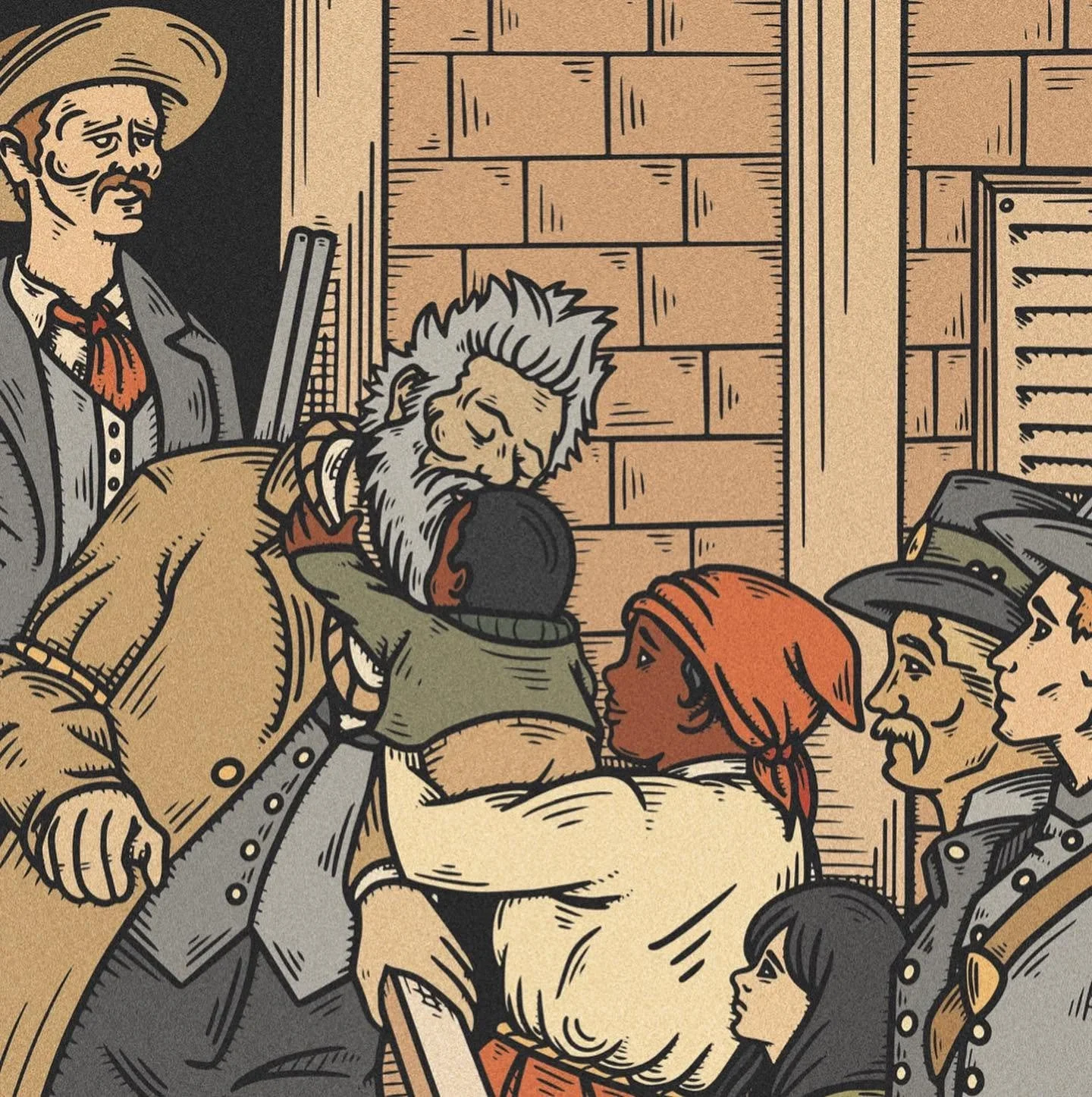
“The Last Moments of John Brown” - Ency
Imagine the Future Differently
Lately, I have been particularly taken by two quotes. The first is a thought from epic poet and friend Malcolm Guite, who said,“The imagination is a truth-bearing faculty alongside reason.” The reason I am spending time with this quote is that HopeWords is currently planning a conference in Boston at Converse Hall, formerly known as Tremont Temple, this fall to explore this proposition alongside Guite and several of his friends and artistic collaborators.
The second quote is from Jesus Imagination, where Leonard Sweet writes, “To imagine Jesus properly is to imagine the future differently.” In many ways, these two propositions have guided, perhaps unknowingly, much of the work we have tried to accomplish through HopeWords.
I believe truth is of utmost importance; I also believe our world is suffering from the onerous blow of reductionism, which identified reason as the only means to truth and thus relegated imagination to the dustbin of electives. So, our work has been to elevate redemptive imagination alongside reason.
In doing this, we often elevate people who reason seems to have little use for. That’s why you see HopeWords take children's authors seriously and place them alongside theologians. Why we champion painters and prophets and poets. Why we seek out people who live in the in-between, the mestizos, whose experience, as Dr. Justo Gonzalez says, is a seedbed of creativity and imagination. Similarly, it’s why we magnify the voices of those with differing abilities, because imagination is often not a luxury for them but an essential tool to make sense of a world in which they do not quite fit. We believe those in whom reason finds little value might well have been the sages in an alternative world that had chosen to value imagination over reason.
The second quote makes me a little more uncomfortable. “To imagine Jesus properly is to imagine the future differently.” What does it mean to imagine the future differently in practice?
Take the prophets of the Old Testament who operated in wild imaginings of alternative futures. They spoke of lions lying down with lambs and swords being beaten into plowshares. But what do we do with these unrealized hopes? These truths? These revelations?
Jürgen Moltmann wrestles with this same question when he writes:
"That is why faith, wherever it develops into hope, causes not rest but unrest, not patience but impatience... Those who hope in Christ can no longer put up with reality as it is, but begin to suffer under it, to contradict it. Peace with God means conflict with the world, for the goad of the promised future stabs inexorably into the flesh of every unfulfilled present. If we had before our eyes only what we see, then we should cheerfully or reluctantly reconcile ourselves with things as they happen to be. That we do not reconcile ourselves, that there is no pleasant harmony between us and reality, is due to our unquenchable hope."
Imagination, for better or worse, can make it hard to put up with reality as it is. Painfully, for the most imaginative, we can begin to suffer under its weight. We can be overtaken by whys. We can grow weary of excuses. We can struggle with despair because, sometimes, hope seems impossible.
Witnesses to New Creation
So, what’s the answer?
“[Timothy Gilbert] was a pew-holder in the Charles Street Baptist Church, and that church had certain regulations which prevented members from introducing on the floor of the sanctuary persons of African descent. This grieved the righteous soul of the good deacon, and he determined to test its legality.” So, one Sunday, he invited a black friend to sit with him at church, “…the result, which might have been anticipated, (was a) serious collision with his white brethren whose race prejudices were greater than his own. The outcome of the affair was that Mr. Gilbert abandoned Charles Street and, with a few kindred spirits, inaugurated the Tremont Temple enterprise about the year 1838. The congregation thus called into being was exceedingly small with an undue proportion of erratic and aggressive souls.”
To Gilbert, the answer was to live as a witness to the alternative future. As a teenager in a Pentecostal church, I thought the word “witness” was inescapably tied to knocking on doors or handing out little tracts. But the real meaning is far richer. A witness is someone who bears faithful testimony.
Mr. Gilbert was a man who imagined an alternative future and began living as a witness to it. He imagined a place where black and white Christians could worship together. Rather than merely arguing for that future, he performed it. He sat beside a black brother in church as though the Kingdom had already arrived. In doing so, he contradicted the current world. Eventually, he left his church and helped form a new one where all were welcome.
I love the last line of the quote, written a couple of decades later by the then pastor of Tremont Temple, reflecting on the church’s heritage. Mr. Gilbert was joined by an “exceedingly small” number of people with “an undue proportion of erratic and aggressive souls.”
This is obviously a tongue-in-cheek compliment describing the kinds of people who would join the “good deacon” in living in contradiction to the world around them. These same terms have been laid on many of the great Christians who challenged the systems of their day. Words like these were certainly used to describe Moses and Jesus, William Wilberforce and Dorothy Day. John Perkins would probably call them “good troublemakers.” They were the radicals, reformers, revivalists, and rabble-rousers.
These are instinctively my people.
Burning Hope
I grew up a child of the labor movement and spent numerous days on picket lines singing labor songs with many an erratic and aggressive soul. Yet here is the exact spot where things become complicated. The danger is not imagination itself. I think the danger is what Paul calls vain imaginations. Not every vision of an alternative future is a baptized one. But speaking to Christians in particular, even redeemed imaginations can become vain when we begin to believe that God's kingdom can be established by the strategies of human empires.
The temptation is always there: to believe justice can be achieved through hatred. That holiness can be produced through control. That revival can be manufactured through technique. That peace can be secured through violence. That New Creation can be built with Pharaoh’s tools.
Whenever we begin to believe that the future depends primarily upon us, we have ceased bearing witness and have begun making idols of ourselves. So, my constant struggle is how to bear witness to the truth of the inbreaking Kingdom while also bearing witness to the Beatitudes.
Consider the Mine Wars in West Virginia. They brought national attention to the abusive practices that many miners and their families had endured for generations. But I do not believe armed militias of miners were the most imaginative response to the private armies of the companies.
Or consider John Brown. Tremont Temple hosted a gathering where Ralph Waldo Emerson raised money for Brown's family after the raid on Harpers Ferry, in West Virginia, of course. Brown was a Christian abolitionist who imagined a future where slavery no longer existed, and every person was free. He was unwilling to reconcile himself to the world as it was. In that sense, he was every bit an erratic and aggressive soul. Brown was not lacking imagination. He possessed an extraordinary imagination. He simply came to believe that the future he saw could only be brought about through violence.
He invited his friend Frederick Douglass to join him. Douglass shared his vision of the future, but I believe he possessed a more cruciform imagination than Brown.
Howard Thurman, in his classic Jesus and the Disinherited, makes this case. His book is divided into four main sections: Fear, Deception, Hate, and Love. The book is challenging because Thurman argues that fear, deception, and even hatred are understandable responses for those whose backs are against the wall. He shows how they can seem effective. One could argue that the Mine Wars contributed to labor reforms and that Brown's raid was one of the sparks that ignited the Civil War, which ultimately brought an end to slavery.
Yet Thurman warns of hatred, “While it lasts, burning in white heat, its effect seems positive and dynamic. But at last it turns to ash.” More importantly for those of us who value imagination as a truth-bearing faculty, he writes, “Above and beyond all else, it must be borne in mind that hatred tends to dry up the springs of creative thought in the life of the hater, so that his resourcefulness becomes completely focused on the negative aspects of his environment. The personality's urgent need for creative expression is starved to death. A man’s horizon may become so completely dominated by the intense character of his hatred that there remains no creative residue in his mind and spirit to give to great ideas, to great concepts.”
The warning is profound. Hatred kills the imagination. It may achieve results, but it eventually starves the soul of the very creativity needed to imagine a new future. Instead, Thurman offers the faithful testimony of Jesus. He argues that Jesus had every reason to choose fear, deception, or hatred, yet chose something far more imaginative and powerful: He chose to love.
The Radical Witness of Love
Admittedly, this is not easy. It requires us to forgive our enemies seventy times seven times. This is as scandalous to our modern ears as it was to his disciples, and Jesus understood the near-impossibility of His command, which is why He followed it with a teaching about the necessity of faith. Or as Miroslav Volf writes, “In the light of the justice and love of God, hate recedes, and the seed is planted for the miracle of forgiveness.” This witness requires the miraculous, and even then, we are not without our doubts as we try to live it out.
Thurman captures the struggle perfectly as he imagines the internal conversation of one who chooses love, “Suppose I have misread the will of God. Suppose I am really acting in this way because I do not have the courage to hate. Suppose those I am learning to love turn and rend me with added contempt and condescension. Then what?”
Oh, the courage and perseverance this radical choice requires. The hardest part of witnessing to New Creation is becoming the kind of person who can do so without losing sight of the cross along the way.
The difference between Timothy Gilbert and John Brown was not the future they imagined. The difference was how they chose to witness it in their lives.
As we live in the wasteland, an Arthurian metaphor in honor of Malcolm, HopeWords longs to find and champion people with redeemed imaginations that can inspire us to live lives of witness to New Creation. We listen for the songs of the naiads. We search for signs of renewal in widow places and forgotten towns in the overlooked and the disinherited. And in the end, we are just an “exceedingly small” group of friends, with “an undue proportion of erratic and aggressive souls” who believe in the miracle of forgiveness and who trust in the witness of love.
Travis Lowe
Travis Lowe is a husband, father, banker, minister, writer, and co-founder of HopeWords Writers’ Conference who has time and time again found inspiration in his childhood home, the Appalachian mountains. You can read more of his essays at pastortravis.medium.com.
Ency
Ency is an Appalachia-based visual artist. You can find more of his work in his book #NuturedNature or on instagram @ency_art.
