
“Light” - Cheryl Eichman
“Poetry includes science, and the man who will advance science most, is the man who, other qualifications being equal, has most of the poetic faculty in him.” — George MacDonald, “Wordsworth’s Poetry,” in A Dish of Orts
William Wordsworth and Samuel Taylor Coleridge published Lyrical Ballads in 1798. Starting off with Coleridge’s “Rime of the Ancyent Marinere,” Lyrical Ballads was a manifesto of early British Romanticism. The tiny, hand-sized volume also included Wordsworth’s poem “Tables Turned,” which concludes with these memorable lines:
“Sweet is the lore which nature brings;
Our meddling intellect
Misshapes the beauteous forms of things;
— We murder to dissect.
Enough of science and of art;
Close up those barren leaves;
Come forth, and bring with you a heart
That watches, and receives.”
By “science” Wordsworth meant reductionistic science, and by “art” he meant not poetry but technology (i.e., “artifice”) cut off from human values, particularly in the industrial revolution. For Wordsworth, there is a deeper way of seeing more to reality than meets the eye. What might this mean for the restoration of science itself?
In an essay on Wordsworth, George MacDonald penned an intriguing aphorism: “poetry includes science.” For MacDonald, science participates in the poetic character of reality as much as the creative arts. A scientific imagination is essential to apprehend the natural order. From ancient times, “logos” referred to the source of order underlying both nature and creative art, so we might paraphrase MacDonald’s aphorism as “the logos includes science.” Through the imagination we apprehend the deeper principles or logos of nature. There is no dichotomy between science and the arts. We are called to integrate the so-called “two cultures.”
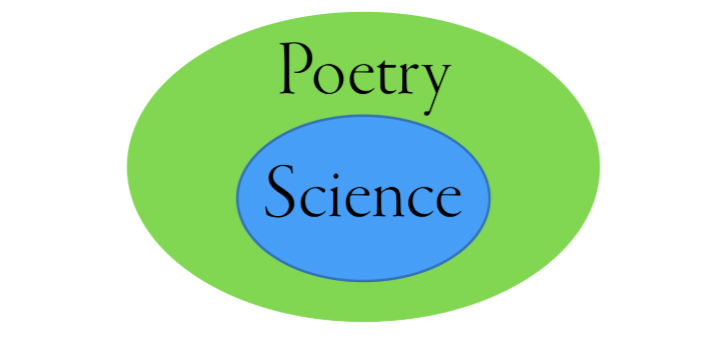
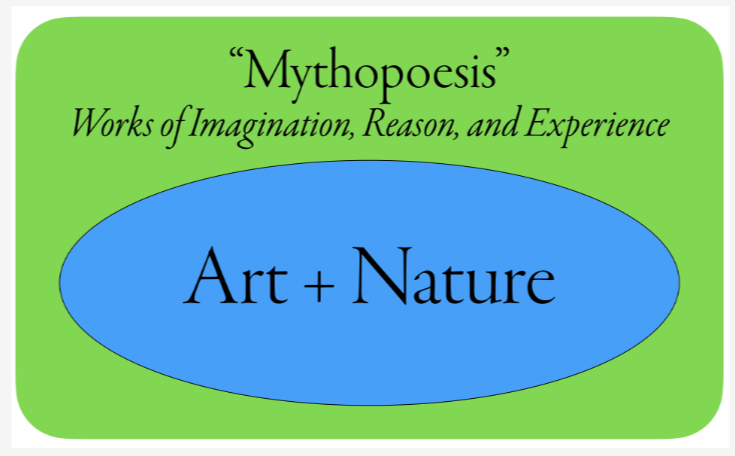
Some poetry is not science, but all true science is poetic in nature (Figure 1). Poetry and science are interwoven in an intimate and dynamic relationship in which poetry has priority in some way. The significance of MacDonald’s proclamation that “poetry includes science” lies in its integrated rather than dualist conception of art and nature.
C. S. Lewis offered a succinct characterization of an age-old debate by singling out the ancient views of Plato, Aristotle, Philostratos, and Plotinos (English Literature in the Sixteenth Century, pp. 318-321). Lewis did so in order to introduce two poets whom MacDonald also loved: Philip Sidney, author of the sonnet sequence Astrophel and Stella, and Edmund Spenser, author of The Faerie Queene.
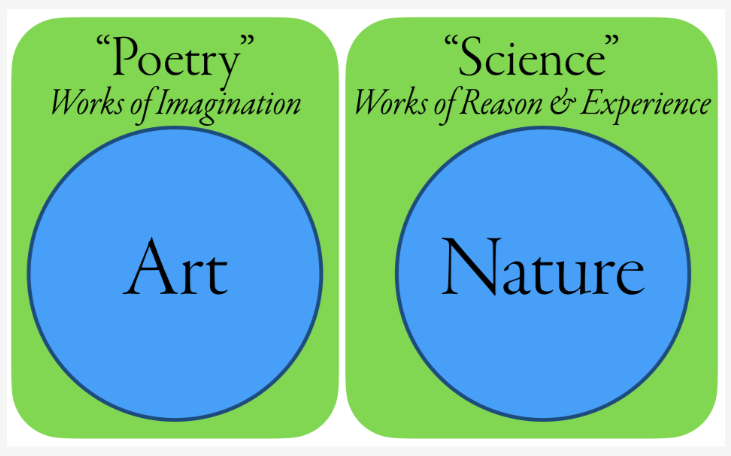
For Plato and Aristotle, Lewis explained, art imitates nature. In this dualist view, it is all too easy to assume that we know nature through reason and experience but pursue art by means of the imagination. Art becomes, at best, merely a copy of reality, not reality itself, nor a means for exploring reality. Imagination leads to a feigning of reality, even a flight from reality, rather than a means for discovering truth. Figure 2 represents a dualist conception of art and nature which directly contradicts Figure 1 by restricting the work of the imagination to the realm of art.
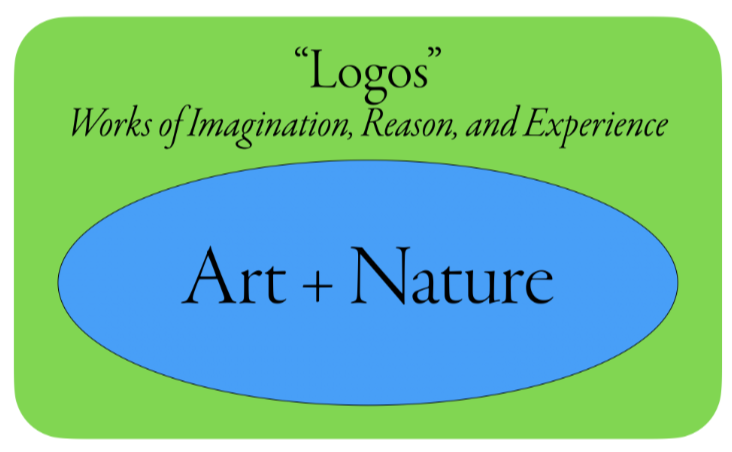
On the other hand, Lewis countered, art and nature alike are realms in which the imagination is at work, alongside reason and experience. In this integrated view, the imagination is required to pursue both of them, apprehending the logos (Figure 3). Considering the renowned sculptures of Pheidias, Philostratos asserted,
“Imagination made them, and she is a better artist than imitation; for where the one [imitation] carves only what she has seen, the other [imagination] carves what she has not seen.” (Life of Apollonios)
A generation after Philostratos, according to Lewis, Plotinos “completed the thought”:
“If anyone disparages the arts on the ground that they imitate Nature... we must remind him that natural objects are themselves only imitations, and that the arts do not simply imitate what they see but re-ascend to those principles (λόγους) from which Nature herself is derived.... Pheidias used no visible model for his Zeus.” (Enneads)
In this integrated vision of art and nature, both derive from a logos which imparts a mutual relation and commonality between them. Art does not merely imitate nature, but both art and nature alike arise primordially from the same transcendent source of order. Poems and science alike derive from higher principles which invite apprehension by the imagination.
Shifting the focus from the sculptures of Pheidias nearly two millennia forward, Lewis explained that a poet like Sidney or Spenser, “in his ‘feigned history’, did not feel that he was retreating from reality into a merely subjective refuge....” For these 16th-century poets, poetry derived from reality no less than science and nature.
This integrated vision of art and nature came down to MacDonald, Wordsworth, and Coleridge. The German Romantics MacDonald loved also shared this vision as well as a broad Christian intellectual tradition.
“In the beginning was the Word [logos], and the Word [logos] was with God, and the Word [logos] was God.... And the Word [logos] became flesh and lived among us, and we have seen his glory, the glory as of a father’s only son, full of grace and truth.” (John 1:1, 14 NRSV)
Logos, of course, is translated “Word” in the first chapter of the Gospel of John.
If MacDonald elevated poetry into a conceptual equivalent of logos to represent the imaginative apprehension of the deeper reality behind all things, might we today substitute “mythopoesis”? Etymologically, “mythopoeic” means myth-making. But this is inadequate. Let’s consider what mythopoesis meant for C. S. Lewis. Does Lewis’s understanding of mythopoesis apply to creative work in science? Does it help us appreciate what MacDonald meant by “poetry includes science”? Does “mythopoesis include science”?
For Lewis, mythopoesis does not necessarily involve the genre of myth. Poetry, novels, painting, music, and creative science might also qualify. In addition, not every myth is mythopoeic. Mythopoesis goes beyond the making of a mere art form: it must achieve a revelation of a deeper reality. It is a lifting of the veil. Mythopoesis reveals and connects us on a personal level with that deeper reality, the logos, the myth behind the myth, which gives rise to all that is true and good and beautiful. In “Myth Became Fact,” an essay in God in the Dock, Lewis wrote:
“Myth is the mountain whence all the different streams arise which become truths down here in the valley; in hac valle abstractionis [‘In this valley of separation’].”
Mythopoesis reveals the mountain. Mythopoesis leads us into truths (“all the different streams”) that are open-ended toward greater mystery (“the mountain”). For Lewis, mythopoesis heals us from the abstractions which beset our thinking and helps us recover an attentiveness to reality in its fullness. Mythopoesis dissipates the clouds that hide the summit from our view.
We need this healing in science as well as in the arts. Throughout history, scientists have described moments of creative discovery as revelations of deeper coherence and unexpected meaning, as glimpses into the inner consistency and relatedness of all things, as illuminating experiences of the reality behind the abstractions. For many, such visions inform the daily practice of scientific work. In The Abolition of Man, ch. 6, Lewis affirmed:
“I even suggest that from Science herself the cure might come.… The regenerate science which I have in mind would not do even to minerals and vegetables what modern science threatens to do to man himself…”
Lewis envisioned a mythopoeic science, a creative mode of science which abjures the reduction of reality to abstract knowledge and joins the creative arts in seeking to behold the valley without losing sight of the mountain.
In The Discarded Image, Lewis pointed to medieval cosmology as an exemplar of the harmony of myth and science. While the findings of science have changed, the separation of science from the realm of meaning reflects a failure of imagination rather than scientific or philosophical necessity. In the Ransom trilogy, Lewis helps us rectify this deficiency, as does MacDonald’s recurring emphasis that “harmony” is the “end of the imagination.” The scientific tradition of “music of the spheres” in medieval cosmology became transmuted into the “harmony of the universe” in modern science. Together, “music of the spheres” and “harmony of the universe” exemplify a long-standing mythopoeic tradition in which “music includes science.”
For Lewis, the writings of Novalis, Kafka, Rider Haggard, and J. R. R. Tolkien were mythopoeic, as were David Lindsay’s Voyage to Arcturus, the novels of Ray Bradbury, and his own Ransom trilogy (see On Stories and Other Essays on Literature). In the preface to Lewis’ MacDonald anthology, Lewis asserted that MacDonald wrote mythopoeically “better than any man.” He implied that MacDonald did so in his novels as well as in his fantasy.
If formation of the imagination is essential for science, then care for the imagination in scientific study and research must not be neglected or disregarded. MacDonald advised, in A Dish of Orts, to “allow no teacher to approach [children] — not even of mathematics — who has no imagination.” The imagination requires continual re-formation, transformation, and renewal through mythopoesis. Book clubs reading MacDonald, Lewis, Tolkien, and their heirs — Galahad and the Grail and others — would make a substantial contribution to scientific formation. A mythopoeic science will need its own lore masters to tell its own stories mythopoeically.
“Mythopoesis includes science” means that scientists undertake an imaginative effort like that of poets and artists to achieve creative fundamental insight into the reality of nature. Unlike students trying to memorize their textbooks, creative scientists strive to apprehend the actual reality of the universe, not merely representations of the universe. Of course, one might remain trapped in a “valley of abstraction,” focusing on a textbook’s propositional statements, models, equations, vocabulary terms – or, even worse, multiple-choice exams! Yet imaginative realism operates on a deeper plane. Imaginative realism is a semantic realism in which a scientist looks through language statements and representations to grasp the underlying logos to which they bear witness, rather than focusing merely analytically upon the statements and representations as abstractions in themselves. The creative scientist looks upstream from facts and truths, seeking to comprehend the valley in light of the mountain. A stereoscopic vision superimposes the valley and the mountain, revealing an integrated whole. To say that poetry includes science, music includes science, or mythopoesis includes science, affirming their intimate relation and seeking their reintegration, amounts to a rejection of reductionism and an assertion of imaginative realism.
To return to MacDonald, poetry includes science because the Father of all is a poet. We and all creation are God’s “poièma” (Ephesians 2:10). Nature, like poetry, comes from him. The natural order and our human nature were created in a sympathy of mutual relation. As we grow in understanding, nature will turn out to display the qualities of the greatest poetry. And if poetry is woven into the natural order, then reading or writing poetry may prepare the heart and mind to comprehend that natural order. Even now nature instructs our poetic and scientific impulses as we learn to attend to it in all its wholeness, to watch and receive with hearts open to whatever it might disclose to us. In reality there is no dualism. Poetry and science dwell together in harmony.
Adapted from Kerry Magruder, George MacDonald and the Scientific Imagination (Winged Lion Press, forthcoming Fall, 2026).
Dr. Kerry Magruder
Kerry Magruder serves as Curator of the History of Science Collections of the University of Oklahoma Libraries. He has been a faculty member of the OU Department of the History of Science, Technology, and Medicine since 2000, and received the John and Drusa Cable Chair of the History of Science Collections in 2011. He blogs at kerrysloft.com. This article is adapted from George MacDonald and the Scientific Imagination (Winged Lion Press, forthcoming Fall, 2026).
Cheryl Eichman
Cheryl Eichman is a passionate follower of God and an integral part of the HopeWords team as project manager and visionary. She desires for people to understand and live out the truth that Jesus loves them. Cheryl can be found exploring the mountains with her family, grabbing coffee with friends, capturing beauty with her camera and written word, or cheering enthusiastically for those around her! You can follow her on instagram @cheryl.eichman.
